

How to Prepare for NEET 2026 in Last 100 Days can make a huge difference in your final rank. Many students feel stressed or confused during this critical period, but toppers use these last 100 days strategically to maximize their scores. For example, in 2024, a Matrix NEET student improved from 510 to 665 marks by following a disciplined 100-day plan. With the right strategy, revision cycle, and focus, you can achieve similar results.
This guide explains How to Prepare for NEET 2026 in Last 100 Days in a simple, student-friendly way. You’ll learn how toppers structure their study time, prioritize chapters, revise effectively, and practice smartly to make every day count toward your NEET success.
Why the Last 100 Days Can Transform Your NEET 2026 Rank
The last 100 days before NEET are the most powerful phase of your preparation. Your basics are already built-now it’s all about speed, accuracy, and smart revision. Toppers use these days to fix mistakes, strengthen high-weightage chapters, and improve their mock test scores. If you plan these 100 days wisely, your score can jump from average to 650+ easily.

Why These Days Are So Important
- Your memory retention is highest
- Revision boosts accuracy
- You stop making repetitive mistakes
- You learn the actual exam strategy
- Your speed improves due to OMR practice
Understanding the NEET 2026 Exam Pattern
Before you start your 100-day preparation plan, you must understand the updated NEET 2026 exam pattern. Knowing the number of questions, marking scheme, and subject-wise weightage helps you plan your study routine better. It also guides you on where to focus more-Physics speed, Chemistry NCERT, or Biology accuracy. A clear understanding of the pattern is the first step to scoring 650+ in NEET.
Updated NEET Exam Pattern
This table will help you understand question distribution and weightage. Keep this in front of you while planning your daily schedule.
NEET 2026 Exam Pattern (NTA Based) |
||||
|---|---|---|---|---|
| Section | Questions | Marks | Difficulty Level | Notes |
| Physics | 45 | 180 | Moderate | Concept + numerical |
| Chemistry | 45 | 180 | Easy-Moderate | NCERT-based questions |
| Biology | 90 | 360 | Easy | Scoring & high-weightage |
Total Marks: 720 , Duration: 3 hours 20 minutes , Marking: +4 / -1
Toppers’ 100-Day Study Plan for NEET 2026
The last 100 days can completely change your NEET 2026 preparation if you follow a structured and topper-tested study plan. Successful NEET toppers focus on smart revision, targeted practice, and consistent mock tests during this phase. This 100-day plan helps you strengthen concepts, improve accuracy, and boost your overall rank. With the right strategy, these final days can turn your hard work into a top score.
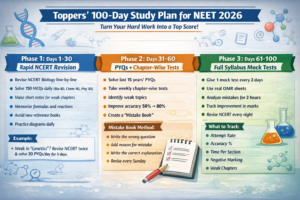
Phase 1 (Days 1-30): Rapid NCERT Revision
The first 30 days are all about building a strong NCERT foundation. Toppers revise NCERT quickly but effectively to refresh concepts before starting heavy practice. This phase ensures your basics are strong enough for the next stages of preparation.
What to Do
- Revise NCERT Biology line-by-line (Best Biology Books for NEET 2026)
- Solve 150 MCQs daily (Bio 80, Chem 40, Phy. 30)
- Make short notes for weak chapters
- Memorize formulas and reactions (Best Physics Book for NEET)
- Avoid new reference books
- Practice diagrams daily
Phase 2 (Days 31-60): PYQs + Chapter-Wise Tests
The next 30 days focus on applying your concepts through PYQs and chapter-wise tests. This phase helps you understand the exam pattern, strengthen weak topics, and improve accuracy. Toppers use this period to identify mistakes early and correct them before the final 40 days.
What to Do
- Solve last 15 years’ PYQs
- Take weekly chapter-wise tests
- Identify weak topics
- Improve accuracy from 50% → 80%
- Create a “Mistake Book”
Mistake Book Method
- Write the wrong question
- Add reason why you made the mistake
- Write the correct explanation
- Revise it every Sunday
Phase 3 (Days 61-100): Full Syllabus Mock Tests
Full Syllabus Mock Tests is focused on practicing full-length tests to evaluate your preparation, strengthen weak areas, and improve speed and accuracy. This phase simulates real exam conditions, helping you build confidence and refine your strategy for NEET 2026.
What to Do
- Give 1 mock test every 2 days (What is a Mock Test in NEET?)
- Solve the paper on a real OMR sheet
- Analyze mistakes for 2 hours
- Track improvement in marks
- Revise NCERT every night
What to Track
- Attempt rate
- Accuracy (%)
- Time taken per section
- Negative marking
- Weak chapters
Daily Study Timetable for the Last 100 Days
A well-structured daily timetable is crucial for the last 100 days of NEET preparation. It helps you organize your study sessions, balance revision and practice, and ensure consistent progress. Following a disciplined timetable maximizes efficiency, keeps stress low, and boosts confidence as the exam approaches.
You can follow this timetable exactly or adjust it based on your coaching timing.
| Daily Study Plan | |
|---|---|
| Time | Task |
| 6-9 AM | Biology NCERT Revision |
| 9-11 AM | Physics Concepts + Numerical |
| 11-12 | Formula/Notes Revision |
| 2-5 PM | Chemistry NCERT + Questions |
| 6-8 PM | MCQ Practice |
| 9-10 PM | Mistake Book Review |
Most Important Chapters for NEET 2026 (Subject-Wise)
Identifying high-yield chapters is crucial for effective NEET preparation. Focusing on the most important topics in each subject helps maximize your score in less time, ensures efficient revision, and boosts your confidence for NEET 2026. This subject-wise breakdown highlights chapters that frequently appear in the exam and carry significant weight.
Important Physics Chapters
In NEET, certain Physics chapters carry more weight and are frequently asked in the exam. Focusing on these important chapters helps strengthen concepts, improve problem-solving speed, and maximize your scoring potential.
- Modern Physics
- Optics
- Electrostatics
- Current Electricity
- Semiconductors
- Error & Measurement
Important Chemistry Chapters
Some Chemistry chapters are high-yield and frequently appear in NEET exams. Prioritizing these chapters helps you focus on key concepts, solve questions efficiently, and score higher with targeted preparation.
- Chemical Bonding
- Thermodynamics
- Organic Chemistry Basics
- Coordination Compounds
- P-block Elements
- Biomolecules
Important Biology Chapters
Certain Biology chapters are highly important and carry significant weight in NEET. Focusing on these chapters helps you strengthen core concepts, retain information effectively, and maximize your score in the exam.
- Human Physiology
- Ecology
- Genetics & Evolution
- Cell Biology
- Plant Physiology
- Reproduction
Toppers’ Proven NEET Revision Strategy
Revision is the key to retaining concepts and boosting confidence before NEET. Toppers follow a structured approach that combines quick reviews, practice questions, and focused weak-area improvement. Implementing these proven strategies ensures efficient preparation, minimizes mistakes, and helps maximize your score on exam day.
The 3-Cycle Revision Method
- Cycle 1: Full revision of all chapters
- Cycle 2: High-weightage chapters
- Cycle 3: Only weak topics
Create a Formula + Diagram Book
- Physics → all formulas + units
- Chemistry → reactions + exceptions
- Biology → diagrams + flowcharts
MCQ Practice Strategy for NEET 2026
Regular MCQ practice is crucial for developing accuracy, speed, and exam confidence. A focused MCQ strategy helps you identify weak areas, reinforce concepts, and adapt to different question patterns, ensuring you are fully prepared for NEET 2026.
How Many MCQs Should You Solve Daily?
Solving the right number of MCQs daily is essential for consistent practice without burnout. Maintaining a balanced approach helps strengthen concepts, improve accuracy, and build exam stamina for NEET 2026. Here’s a topper-approved daily MCQ routine:
- Biology: 80 MCQs
- Chemistry: 50 MCQs
- Physics: 40 MCQs
- Total: 170 MCQs per day (minimum)
The Error Analysis Method
The Error Analysis Method is a proven strategy used by NEET toppers to identify and learn from mistakes. By analyzing errors in practice questions and mock tests, you can strengthen weak areas, avoid repeating mistakes, and improve accuracy, boosting your overall performance.
Step-by-Step Error Analysis Method
- Write each wrong question in your “Mistake Book”
- Add the correct explanation
- Write why you selected the wrong answer
- Revise these mistakes every Sunday
- Reattempt them after 7 days
NEET 2026 100-Day Do’s and Don’ts
The last 100 days before NEET are crucial, and following the right strategy can significantly boost your score. Knowing what to do-and what to avoid-helps you stay focused, manage time effectively, and prevent common mistakes. These essential Do’s and Don’ts will guide you toward a disciplined, stress-free, and productive final preparation phase.
Do’s
- Revise NCERT daily
- Take mock tests regularly (What is a Mock Test in NEET?)
- Analyze mistakes for at least 2 hours
- Practice OMR sheets
- Focus more on high-weightage chapters
Don’ts
- Don’t start new heavy reference books
- Don’t skip Biology diagrams
- Don’t solve random MCQs
- Don’t overstudy (12+ hours is not required)
- Don’t compare your preparation with others
Conclusion
Preparing for NEET 2026 in the last 100 days is all about smart planning, disciplined execution, and consistent practice. By following toppers’ proven strategies-focused revision, daily MCQ practice, regular mock tests, and effective time management-you can significantly boost your confidence and accuracy. Remember, these 100 days can completely transform your preparation if you stay dedicated, avoid distractions, and trust your process. With the right approach and mindset, cracking NEET 2026 with an excellent score is absolutely achievable. Stay focused, stay positive, and give your best till the very end.
Also Read:
Best Medical Colleges in India
FAQs
Yes, 100 days are enough to crack NEET 2026 if your basics are clear and you follow a smart revision-focused strategy. With NCERT-based study, daily MCQs, and regular mock tests, many students significantly improve their score even in the last 3 months.
You should study 8-10 focused hours daily for NEET preparation, prioritizing quality over quantity. Divide time between revision, MCQ practice, and mock test analysis to maximize efficiency and avoid burnout.
Focus on NCERT first, as most NEET questions are directly or indirectly based on it. Once concepts are clear, practice MCQs daily to improve accuracy, speed, and exam confidence.
You should take 25-40 full-length mock tests before NEET, depending on your preparation level. More importantly, analyze every mock thoroughly to identify weak areas and avoid repeating mistakes.
If you’re weak in Physics, focus on high-weightage and formula-based chapters first like Modern Physics, Current Electricity, and Semiconductors. Study from NCERT + one good reference, and practice daily numerical to build confidence and accuracy.