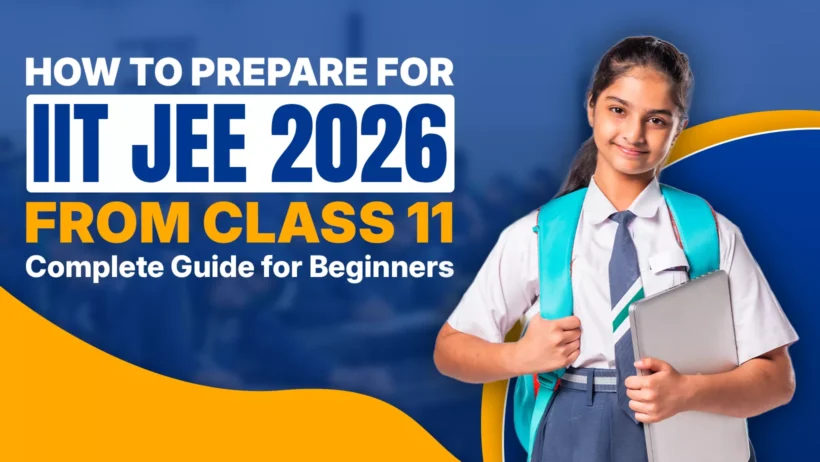
How to Prepare for IIT JEE 2026 from Class 11 is a crucial question for every serious aspirant aiming to secure a top rank. Success in IIT JEE is not achieved overnight-it is built gradually with consistent hard work, discipline, and smart strategies. As students move from Class 10 to Class 11, the subjects become more challenging, making it essential to have a clear plan on How to Prepare for IIT JEE 2026 from Class 11 effectively.
The advantage of starting in Class 11 is that it gives students two full years to develop strong concepts, improve problem-solving skills, and build discipline-factors that directly impact JEE ranks. This period also allows for a balanced approach to school studies, coaching, self-study, revisions, and mock tests, ensuring students can maximize preparation without burning out and maintain a steady path toward success in IIT JEE 2026.
So, if you are curious to know more, we have created an IIT-JEE preparation guide. We will take you through a step-by-step process of everything you need to know about how to prepare for IIT JEE in class 11 smartly, confidently, and consistently.
What Is The Prestigious IIT JEE Entrance Exam?
When it comes to IIT, you may have heard that JEE is in 2 parts: JEE Main and JEE Advanced. JEE Main is a qualifying test for the JEE-Advanced admissions. It is also an entrance exam for admissions in the NITs, IIITs and other top engineering colleges. The students who want to join the prestigious Indian Institutes of Technology (IIT) need to crack the JEE Advanced after the JEE Main entrance exam.
Consequently, when you say how to prepare yourself for the IIT JEE exam, you must keep in mind that you are preparing in a broad enough and deep enough sense to be able to pass both stages. This would translate into precision and quickness in the case of Main, and analytical problem-solving in the case of Advanced.
Read More: Highest IIT Placement Package: Highest Salary Offers & Trends
IIT JEE Entrance Exam Class 11 Syllabus
In Class 11, you will establish the framework for the IIT JEE preparation strategy, and here the syllabus is almost identical to JEE Main and Advanced. This is also the time to build your conceptual strength.
In Physics, topics like Kinematics, Laws of Motion, Work, Energy & Power, and Gravitation set the basis for much larger chapters in Class 12.
Whereas in Chemistry, all the Basic Concepts, Equilibrium, Thermodynamics, and Organic Mechanisms will all be built upon in the subsequent year. Likewise, in Mathematics, some chapters extend across Algebra, Trigonometry, Coordinate Geometry, and Basic Calculus.
As well as taking a smart and effective strategy for IIT JEE preparation from Class 11, clearly mark all of these topics as important. Or, you can highlight large weightage chapters and revise them again and again, rather than skimming the surface.
How To Set Up Your IIT JEE Foundation in Class 11?
One of the most asked questions in the case of JEE is whether coaching is compulsory or not. However, the fact is, coaching brings order, accuracy and exposure to JEE problems. However, your success will largely depend on the degree you take it seriously, regardless of whether you are coaching, taking online lectures or studying on your own.
In the initial days of your preparation, you can start with the NCERT books. For Physics, mix NCERT with Concepts of Physics by H.C. Verma, then subsequently practice from the D.C. Pandey series.
Chemistry is slightly different; use NCERT religiously for Inorganic, combine NCERT with O.P. Tandon for Physical, and MN Chauhan for Organic Practice. As for Mathematics, RD Sharma or the Cengage/Arihant series are good places for keeping your confidence and building depth.
Remember, no matter which path you choose, focus on how to prepare for IIT JEE Advanced after preparing for the JEE Main. This way, you automatically maintain a high level of preparation.
Strategy for IIT JEE Preparation From Class 11
The first three months of Class 11 will be very important. You can develop habits, lay out a routine, and understand how you learn. Start with a slow pace but stay consistent. Read the chapters you learned on that day in school, and then gradually step into JEE-level books to deepen your understanding.
Once you establish a routine, you and your practice will be inseparable. Ideally, spend around five hours a day in addition to school/coaching on self-study. Initially, you will spend a little bit more time on theory, and gradually increase the proportion of problem-solving later on.
Surprisingly, learning how to prepare for IIT JEE in class 11 is like climbing your mountain – you need to find your pace before you can pick up speed.
How To Make A Timetable for IIT JEE Preparation?
A good timetable is the much-needed foundation of a good IIT JEE preparation strategy. Many students think that when they ask how to make a timetable for IIT JEE preparation, it is going to be about cramming every hour of their life in studying for the exam, but it is not!
Instead, it is about balance and reality. Find out what hours of the day are your best focus hours. Plan your most difficult subject during that time. Plan the next allocation in hours for a more moderate subject, and then the remaining hours for easier subjects. Every day should include:
- 2 hours of study of concepts in depth
- 2 hours of practice problems
- 1 hour of revision
Do not study the same subject for long periods. Mix subjects within two hours, and you will keep your brain a little fresher. For your mind to relax, keep at least one day every week that has a lighter study load. You need to do this because consistency is better than cramming for a long time in huge study sessions.
How to Study Each Subject Smartly for IIT JEE 2026?
A strong strategy for IIT JEE is to build your preparation layer by layer rather than going for it all at once. The following is a proven three-layer process that you MUST follow religiously:
Theory Building
You need first to pick up your NCERT textbook, go over the lectures in coaching classes, and understand the base concepts. Do not neglect diagrams or how to use examples.
Moderate Problems
You will then be in a position to check out solved examples and level-1 problems in a book for reference. This will give you a great boost to your confidence.
JEE Problems
You can then tackle problems with a higher level of complexity and exercises that will test your brain, mixing concepts just as JEE Advanced questions are constructed.
You will develop depth, speed, and accuracy methodically by repeating this three-layer approach for each chapter.
Physics Study Approach
Physics should be studied conceptually. Always visualize situations as real-life scenarios instead of treating them as abstract examples. Draw free-body diagrams, understand vector decomposition, and derive formulas yourself instead of memorizing. Once the concept settles, only then move into numerical application.
Practice derivations regularly, as it not only clarifies logic but also helps you during Advanced, where questions are often unfamiliar but based on fundamentals.
Math’s Study Approach
Mathematics requires relentless problem-solving. While understanding theory is important, the bulk of your learning happens by actually solving problems.
Every day, practice new problems, solve old mistakes, and try to think outside of the box when solving the same question. This builds sharpness and agility, which is needed while attempting mixed questions in the IIT JEE 2026 entrance exam.
Chemistry Study Approach
Chemistry demands different methods across its three branches:
- Physical Chemistry needs conceptual clarity and mathematical problem-solving abilities.
- Organic Chemistry is like a flow of reactions, keeping rewriting mechanisms until they become muscle memory.
- Inorganic Chemistry is rooted deeply in NCERT, so memorise using stories and tricks to make it easier.
When and How to Begin Solving JEE-Level Problems?
The major confusion that beginners will typically face when looking into how to prepare for the IIT JEE entrance exam is, When do you start to solve higher-level questions? The answer is as soon as you complete a chapter fully conceptually, do not wait for a couple of months.
Initially, focus on getting the exercises out of the school/coaching modules, then move on to JEE Main past year questions, and finish off with JEE Advanced level problems. Regularly practice mixed sets of questions to develop your ability to switch your thinking style in a flash. Hold onto a notebook for mistakes, write down your weaknesses, silly mistakes, and confusions. Afterwards, review this notebook weekly so that it will not happen again.
How To Prepare Your Revision Strategy?
Revision should go hand in hand with learning, and be planned, not a task you do when you’ve finished a syllabus and are panicking about revision. This revision plan is to be made into two main cycles:
- Every Week: (Every Sunday)
Go through the prior week of topics briefly (like you did for tabulating the syllabus). Then do 10 to 15 new questions to aid memory recall.
- Every Month: (the last couple of days of each month)
Plan to spend a good three days re-reading the chapters of the past month. Try an entire mock test as well as review how well you did with all of the subject matter from the previous month.
This structured plan is the basis of your long-term strategy for IIT JEE preparation from class 11. It keeps your concepts fresh for a longer time during the preparation.
Read More: JEE Advanced 3rd Attempt Removed: Impact of This on IIT Aspirants
How to Prepare for IIT JEE 2026 in Class 11 Without Burnout?
Two years is a long time. Motivation wanes, and distractions, uninterrupted, create pressure. There is no solution, only consistency, not perfection. Here are some ways which help you- how to prepare for the IIT JEE 2026:
- Break the journey up into milestones every month.
- Reward yourself for completing the tough material within a chapter.
- Gradually reduce distractions, not a complete cut off of the social side of life.
- When you feel down, ask seniors/mentors for advice.
- Think about why you want to achieve, and leave a reminder visual above your study desk.
The answer is by anchoring discipline into habit, so that even a bad day leads to proper testing progress.
Also Know About: Matrix Academy
Conclusion
Understanding how to prepare for IIT JEE in class 11 is all about making smart, sensible approaches from day one and not panicking in the last 6 months. Develop a strong conceptual foundation, an effective, structured timetable, revision cycles, practice without fear, and give yourself two years to make consistent, steady improvement, as opposed to quick, sensational improvement.
Continue fine-tuning your IIT JEE preparation plan, take it easy on the tough days, and trust the process with a true heart as you plan your studies. If you work with sincere intent, all of the practice tests, late nights studying, and tiny improvements you see at the start will be added together.
Two years from now, when you set foot into the IIT campus, as a proud qualifier of the JEE 2026 exam, you will look back at Class 11 and say, – This is where it began. So, start today & fly with high Colors.
Also Read:
FAQ’s
Yes, Class 11 is the foundation year for IIT JEE preparation. Most concepts in Physics, Chemistry, and Mathematics introduced in Class 11 are directly used in Class 12 and in both JEE Main and JEE Advanced. A strong Class 11 base makes Class 12 preparation significantly easier.
Ideally, a Class 11 student should study 4–6 hours daily apart from school or coaching. Initially, focus more on understanding concepts, and gradually increase problem-solving time as you progress.
Yes, it is possible to prepare without coaching if you follow a disciplined schedule, use the right study materials, and practice previous year questions regularly. However, coaching helps with structured learning, expert guidance, and exposure to competitive problems.
Some recommended books are:
Physics: NCERT, H.C. Verma, D.C. Pandey Series
Chemistry: NCERT (must), O.P. Tandon, M.S. Chauhan
Mathematics: RD Sharma, Cengage or Arihant Series
Always complete NCERT first, especially for Chemistry.
You should start solving JEE-level questions immediately after completing a chapter conceptually. Begin with basic exercises, then move to JEE Main questions, and finally attempt JEE Advanced problems.